Why Excel Becomes a Bottleneck
Excel helps businesses start—but as complexity grows, spreadsheets quietly become the obstacle.
Growing Smarter #001 · Month 1, Article 1
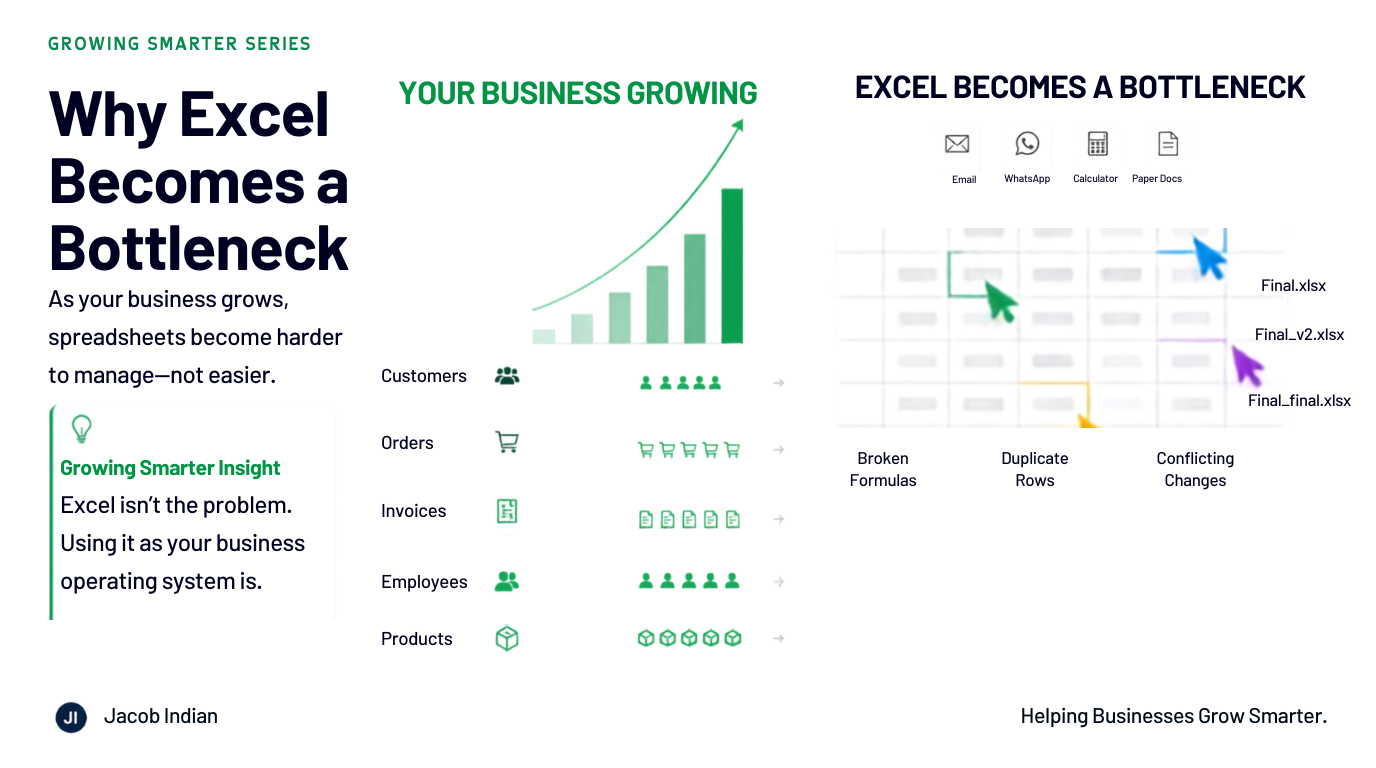
For decades, Microsoft Excel has been one of the most valuable tools in business. From tracking sales and managing inventory to preparing quotations and monitoring expenses, it has helped millions of businesses get started—flexible, affordable, and familiar to almost everyone.
But as a business grows, something changes. The very tool that helped you get started can quietly become the biggest obstacle to your growth.
Excel isn't the problem. Growth is.
When you're a small business with a handful of customers, Excel works remarkably well. A single spreadsheet is easy to manage. One person knows where everything is. Finding information takes only a few minutes.
As your business grows, however, so does the complexity:
- More customers
- More products
- More quotations
- More invoices
- More team members
- More follow-ups
- More decisions
Excel wasn't designed to manage an entire business operation.
The warning signs
Many businesses don't realize they've outgrown Excel until they begin experiencing problems such as:
- Multiple versions of the same spreadsheet
- Team members accidentally overwriting each other's data
- Hours spent searching for the latest file
- Manual copying of information between different sheets
- Difficulty tracking quotation and payment status
- Customer information scattered across spreadsheets, emails, and WhatsApp
- Reports that take hours instead of minutes to prepare
Individually, these issues may seem minor. Together, they consume valuable time, create unnecessary stress, and increase the likelihood of costly mistakes.
The hidden cost isn't Excel. It's manual work.
Consider a simple sales process:
- 1A customer requests a quotation—you prepare it in Excel.
- 2When they approve it, you manually create an invoice.
- 3You update another spreadsheet to track payment.
- 4You send reminders through WhatsApp.
- 5You update yet another sheet when payment is received.
None of these tasks are particularly difficult. The problem is that you're repeating the same information across multiple places.
Every manual step slows your business down.
Growth demands systems, not more spreadsheets.
Many business owners assume the solution is hiring more people. But hiring more people to manage inefficient processes often creates more complexity rather than solving it.
The businesses that scale successfully don't simply add more employees—they build better systems. When information flows automatically between different parts of the business, teams spend less time on administration and more time serving customers, improving products, and driving growth.
Your business should have one source of truth.
One of the biggest operational challenges for growing businesses is fragmented information:
- Sales data is stored in one spreadsheet
- Customer details are in another
- Invoices are saved in folders
- Payment updates come from bank statements
- Conversations happen on WhatsApp
- Important files are buried in email attachments
When information is scattered, decisions become slower and less reliable. Businesses perform better when everyone works from a single, reliable source of information.
So, should you stop using Excel?
Not at all. Excel remains one of the most powerful business tools available—excellent for analysis, budgeting, forecasting, reporting, and ad hoc calculations.
The real question isn't whether Excel is good or bad. The question is whether Excel is being used for tasks it was never designed to handle.
If your spreadsheets have become your customer database, quotation system, invoice tracker, payment register, inventory manager, and business dashboard all at once, you've probably reached the point where growth requires a different approach.
Final thoughts
Every successful business reaches a stage where its processes become more important than its spreadsheets. Growth creates complexity.
The businesses that continue to grow are the ones that replace manual work with efficient systems, giving their teams more time to focus on what truly matters: serving customers and building a stronger business.
Systems help businesses scale.
Growing Smarter is a weekly series by Jacob Indian, sharing practical insights on helping businesses simplify operations, embrace automation, and scale with modern web applications.
Not sure where to start? Download our free Systems Readiness Checklist or book a consultation.
Related posts
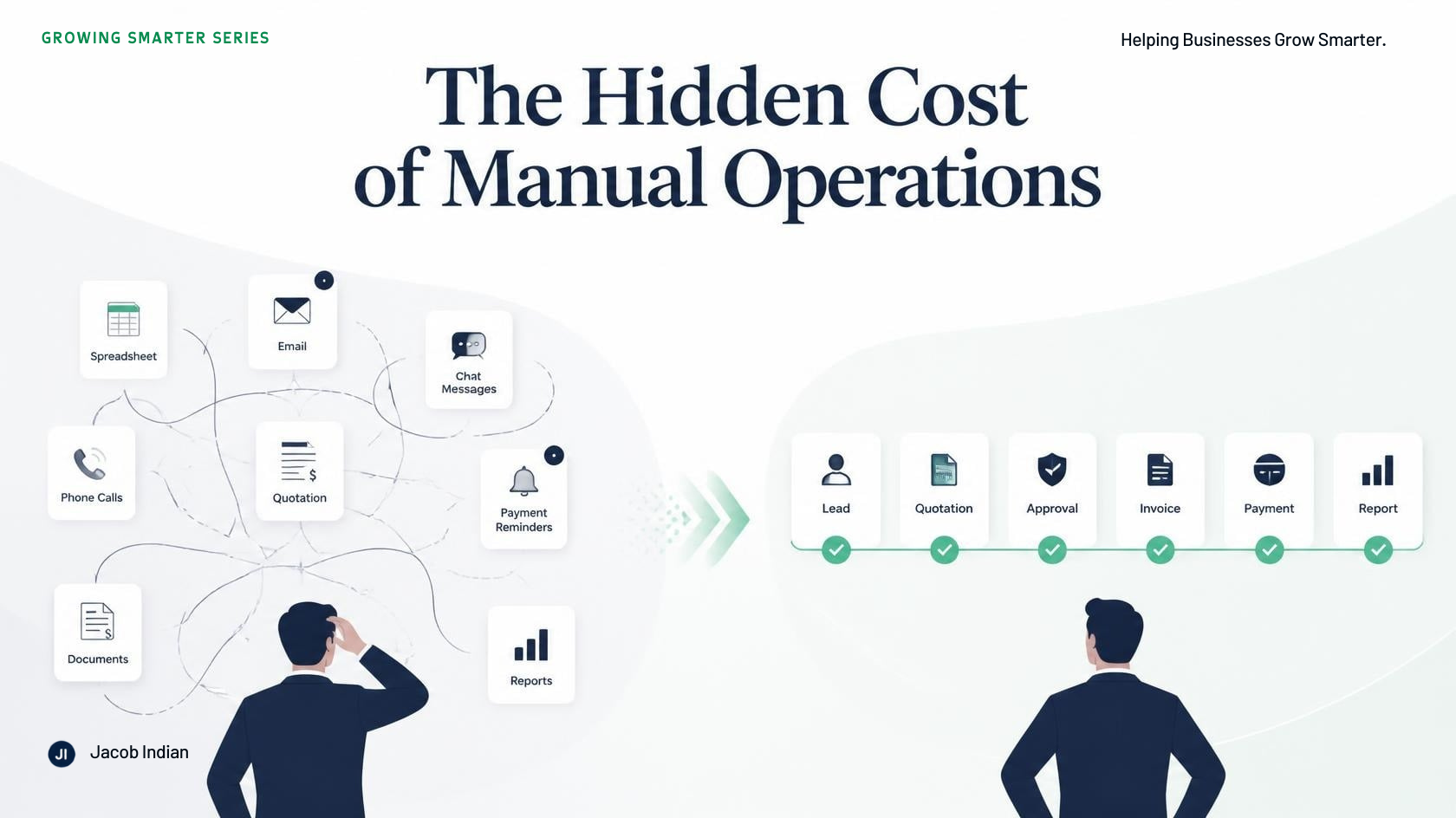
The Hidden Cost of Manual Operations
Manual work feels fine when you are small—until growth multiplies the same tasks. The hidden cost of manual operations, and why better systems beat working harder.

Is Your Business Running You?
There is a stage when you still run the business—but the business also starts running you. How to recognize owner dependency, and build processes that create capacity instead of chaos.

Independence for Your Business: Freedom to Grow Without Being Trapped in Operations
This Independence Day, another kind of freedom: run your business without your business constantly running you. Operational independence for growing SMEs.