Is Your Business Running You?
There is a stage when you still run the business—but the business also starts running you. How to recognize owner dependency, and build processes that create capacity instead of chaos.
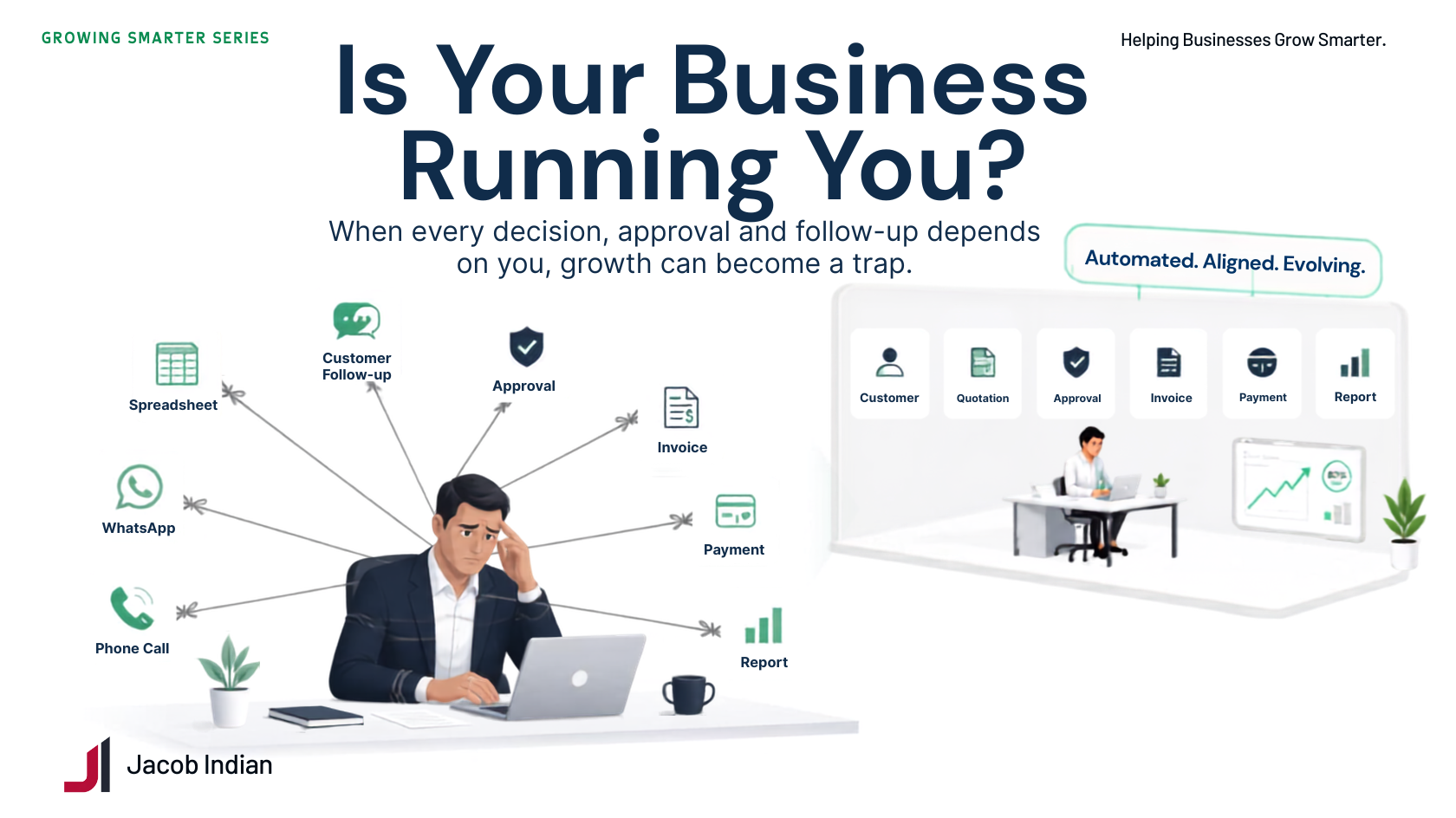
Growing Smarter #004 · Reality of Growing Businesses
There is a stage in almost every growing business when something subtle changes.
At the beginning, you run the business.
You make the decisions.
You speak to customers.
You approve quotations.
You track payments.
You solve problems.
You know what is happening.
It feels like leadership.
Then the business grows.
Suddenly, your phone doesn't stop.
Someone needs an approval.
Someone is asking about a customer's payment.
Someone can't find the latest quotation.
Someone wants to know whether an order has been completed.
Someone needs a report.
Someone needs you to decide what happens next.
You are still running the business.
The Warning Signs Are Usually Small
It rarely happens overnight.
Instead, you start noticing little things:
“Let me check and get back to you.”
“I need to ask the owner.”
“Which spreadsheet has the latest data?”
“Did we follow up with this customer?”
“Can you send me that report?”
“I know how this works—we've always done it this way.”
Each one seems harmless.
Together, they reveal something important:
When Everything Comes Back to You
Consider a typical growing business.
A customer wants a quotation.
The sales person prepares it and sends it to the owner for approval.
The owner reviews it.
The quotation goes back to the sales person.
The customer asks for a revision.
The sales person checks with the owner again.
The quotation is finally accepted.
Someone creates the invoice.
The payment is expected.
A few days later, someone asks:
“Has the customer paid?”
Now the owner checks a spreadsheet.
Or WhatsApp.
Or the bank statement.
Or asks the accounts team.
This isn't necessarily a people problem.
It's a process problem.
The business has grown, but the way information moves through the business hasn't grown with it.
We wrote more about this in The Hidden Cost of Manual Operations.
Your Time Becomes the Bottleneck
There are only so many hours in a day.
If routine decisions require your involvement, your available time becomes a limit on how much the business can handle.
You may have:
- A capable team
- More customers
- More revenue
- More opportunities
But if every important action still needs your attention, the business cannot fully benefit from that capacity.
The result is a strange situation:
The Owner as the “Operating System”
A useful way to recognize this problem is to ask:
“What information exists only in my head?”
Perhaps you remember:
- How to handle a particular customer
- Which quotation needs attention
- Who needs to approve something
- What happens after an order is received
- Which employee handles a particular situation
- When a particular customer should be followed up
If removing one person from the business causes routine operations to slow down significantly, you don't have a scalable process.
You have knowledge dependency.
The business is relying on memory instead of a repeatable system.
Being Busy Is Not the Same as Moving Forward
One of the most dangerous aspects of operational dependency is that it can look like productivity.
You are constantly doing something.
Answering messages.
Checking spreadsheets.
Calling employees.
Approving documents.
Reviewing reports.
Following up with customers.
Solving problems.
At the end of the day, you feel exhausted.
But ask yourself:
“How much of today's work actually moved the business forward?”
There is a difference between operational activity and business progress.
A growing business needs both.
But the owner's time should increasingly move toward decisions and activities where their involvement creates the greatest value.
Growth Should Increase Capacity, Not Dependency
Adding more customers shouldn't automatically mean adding more manual coordination.
Adding employees shouldn't automatically mean more questions for the owner.
Adding products shouldn't automatically mean more spreadsheets.
Adding revenue shouldn't automatically mean more administrative work.
Growth should gradually create capacity.
That means designing ways of working that allow the business to handle more without increasing complexity at the same rate.
If spreadsheets are already stretching, read Why Excel Becomes a Bottleneck.
What Does a Better System Look Like?
A system doesn't necessarily mean expensive software.
At its core, a system is simply:
For example:
Instead of:
Customer → WhatsApp → Employee → Owner → Spreadsheet → Email → Follow-up
you could have:
Customer → Quotation → Approval → Invoice → Payment
with clear responsibilities and status at every stage.
The difference isn't just technology.
The difference is clarity.
Everyone knows:
- What happened
- What is happening
- Who is responsible
- What happens next
Visibility Changes Everything
Imagine asking:
“How many quotations are waiting for approval?”
Instead of calling three people, searching WhatsApp, and opening spreadsheets, you can see the answer.
Or:
“Which invoices are overdue?”
The answer is visible.
Or:
“Which customers need follow-up today?”
The answer is visible.
This is what operational visibility provides.
It doesn't remove management.
It makes management less dependent on information hunting.
Delegation Becomes Easier
You cannot delegate effectively when the process exists only in your head.
You can tell someone:
“Just do it the way I normally do.”
But that doesn't create a scalable business.
A better approach is to define:
- What happens?
- Who does it?
- When does it happen?
- What information is required?
- What happens next?
Now someone else can perform the work consistently.
That's the foundation of delegation.
And delegation is one of the foundations of growth.
What Happens When You Step Away?
Here's a simple test.
Imagine you take a week off.
Not an emergency.
Not because something has gone wrong.
You simply aren't available.
Can your business continue?
Can your team:
- Find customer information?
- Check pending quotations?
- Follow up with customers?
- Process invoices?
- Track payments?
- Handle routine approvals?
- See what needs attention?
- Know what happens next?
If the answer is mostly yes, you've built something valuable.
You've created operational independence.
That idea is the heart of Independence for Your Business.
The Goal Isn't to Become Less Important
This is an important distinction.
The answer isn't to remove the owner from the business.
Your experience, judgment, relationships, strategy, and leadership remain extremely valuable.
The goal is to remove you from unnecessary operational dependency.
You should be spending more time asking:
Where should the business go next?
rather than:
Did someone send that invoice?
You should be thinking about:
How do we grow?
rather than:
Which spreadsheet has the latest numbers?
You should be building:
The future of the business.
rather than constantly fixing:
The problems of yesterday.
From Owner Dependency to Business Independence
The transition happens gradually.
- 1Identify the recurring questions. What do people constantly ask you? Those questions reveal where information or processes are missing.
- 2Document the way work happens.Turn “how we've always done it” into a defined process.
- 3Clarify responsibilities. Everyone should know who owns each stage.
- 4Reduce duplicate work. Capture information once and reuse it wherever possible.
- 5Improve visibility. Make important operational information accessible to the people who need it.
- 6Automate where it makes sense. Once the process is clear, technology can remove repetitive manual work.
This is how businesses gradually move from dependency to independence.
Ask Yourself These Five Questions
Take five minutes and answer honestly:
- If I don't respond to a message, does work stop?
- If one key employee is absent, do we struggle to know what to do?
- Do I frequently get asked for information that should already be available?
- Do routine approvals and decisions regularly come back to me?
- Could my business operate effectively if I stepped away for a week?
If several answers are uncomfortable, that's not necessarily bad news.
It may simply mean your business has reached the next stage of its growth.
The Real Meaning of Growing Smarter
Growth isn't just about getting more customers.
It's about increasing the capability of the business.
A business that grows only by adding more people and more hours eventually reaches another limit.
A business that improves its processes, visibility, documentation, and systems can create something much more valuable:
scalable capacity.
That's when growth starts becoming sustainable.
So, Is Your Business Running You?
If every decision comes back to you...
If every problem needs your attention...
If your team constantly asks where information is...
If routine operations consume your evenings...
If stepping away feels impossible...
then perhaps the question isn't:
“How can I work harder?”
Perhaps the better question is:
“What should the business be able to handle without me?”
Because the ultimate goal isn't to build a business that needs you everywhere.
Think About It
If you stepped away from your business for one week, would it keep moving—or would it wait for you?
Growing Smarter is a series by Jacob Indian exploring the realities of growing businesses, digital transformation, automation, business systems, and the operational challenges that appear as companies scale.
Jacob Indian — Helping Businesses Grow Smarter.
Not sure where to start? Download our free Systems Readiness Checklist or book a consultation.
Related posts

Independence for Your Business: Freedom to Grow Without Being Trapped in Operations
This Independence Day, another kind of freedom: run your business without your business constantly running you. Operational independence for growing SMEs.
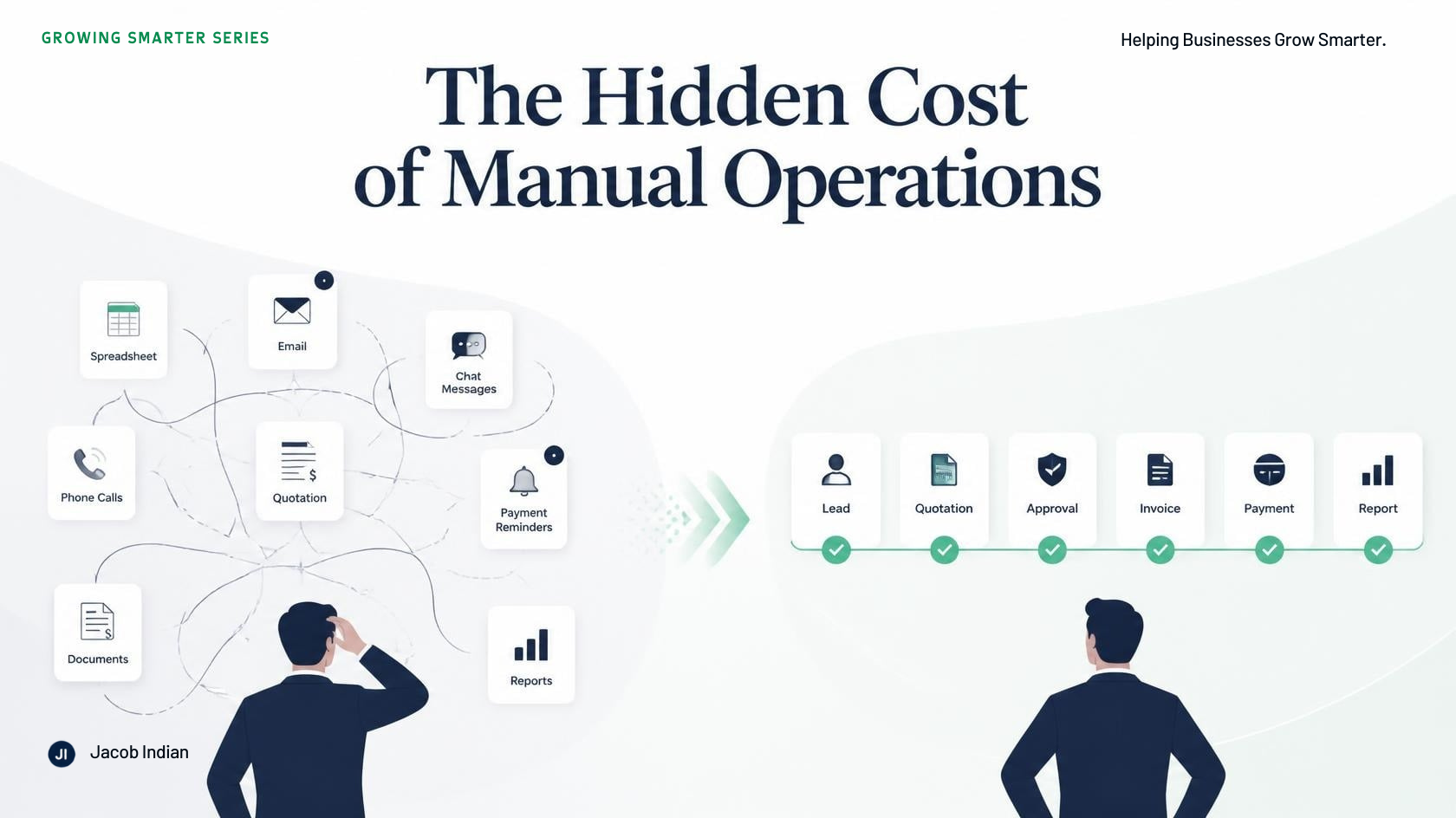
The Hidden Cost of Manual Operations
Manual work feels fine when you are small—until growth multiplies the same tasks. The hidden cost of manual operations, and why better systems beat working harder.
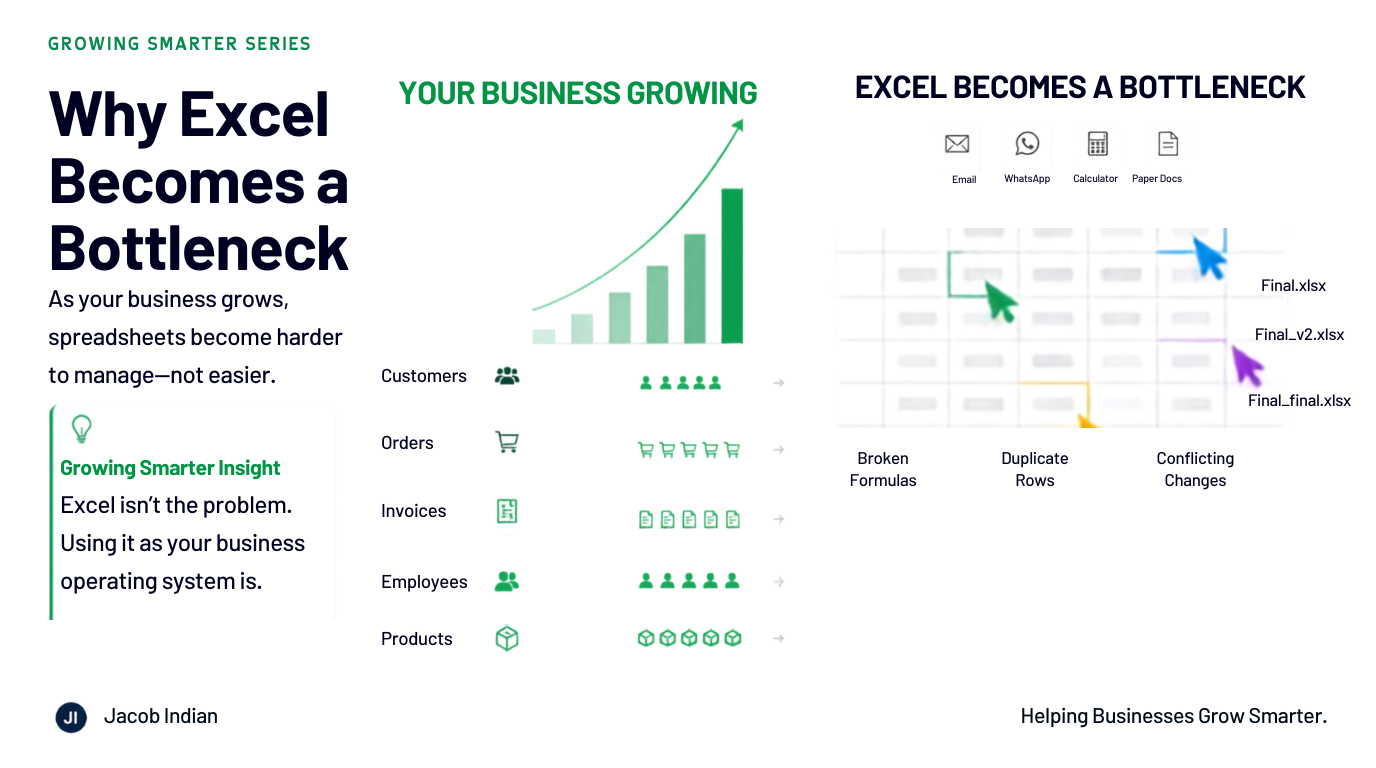
Why Excel Becomes a Bottleneck
Excel helps businesses start—but as complexity grows, spreadsheets quietly become the obstacle.