The Hidden Cost of Manual Operations
Manual work feels fine when you are small—until growth multiplies the same tasks. The hidden cost of manual operations, and why better systems beat working harder.
Growing Smarter #002 · Reality of Growing Businesses
Manual operations rarely look like a problem when a business is small.
A quotation is prepared manually. An invoice is created by copying information from another file. A payment reminder is sent through WhatsApp. A report is prepared at the end of the month.
Everything seems manageable.
Until the business grows.
More customers bring more quotations. More quotations bring more invoices. More invoices bring more payment follow-ups. More employees mean more coordination. More transactions mean more information to track.
At some point, the business isn't simply doing more work.
And that's where the hidden cost of manual operations begins.
Manual Operations Don't Look Expensive at First
The biggest problem with manual work is that its cost is rarely visible on a balance sheet.
You don't receive an invoice saying:
“₹25,000 spent this month on unnecessary data entry.”
Instead, the cost is distributed across dozens of small activities:
- Copying customer information between files
- Re-entering invoice details
- Checking whether a quotation was approved
- Asking someone for the latest status
- Sending payment reminders
- Reconciling transactions
- Preparing management reports
- Searching through WhatsApp conversations
- Correcting mistakes caused by duplicate data entry
Each task might take only a few minutes.
Multiply that by hundreds of transactions and several employees, and those minutes become hours every week.
The Hidden Cost Is Bigger Than Lost Time
Time is only the beginning.
Manual operations introduce several other costs that are much harder to measure.
1. Repeated Data Entry
When the same information has to be entered multiple times, every additional entry creates another opportunity for error.
A customer name changes in one place but not another.
An amount is copied incorrectly.
An invoice contains an outdated address.
A payment is recorded but not reflected in another file.
The problem isn't that people are careless.
People are being asked to perform work that systems can often handle more consistently.
2. Human Error
Manual processes depend heavily on memory, attention, and consistency.
And people make mistakes.
A missed digit in an invoice may seem insignificant.
A missed payment reminder may delay cash collection.
An incorrect quotation can affect customer trust.
A wrong report can lead to a poor business decision.
As transaction volume increases, even a small error rate can become significant.
3. Information Gets Scattered
One of the most common symptoms of manual operations is information fragmentation.
Customer information might be in Excel.
The latest conversation might be in WhatsApp.
A quotation might be attached to an email.
Payment information might be in accounting software.
An important instruction might exist only in someone's memory.
Now imagine someone asking:
“What's the current status of this customer?”
Finding the answer becomes a process of searching rather than simply looking.
That is an operational cost.
The “Ask Someone” Problem
One of the clearest signs that a business is becoming dependent on manual operations is how often people have to ask each other for information.
- “Can you check the status?”
- “Did we send the quotation?”
- “Has the customer approved it?”
- “Was the invoice generated?”
- “Did they make the payment?”
- “Can you send me the latest report?”
When information isn't readily available, employees become the interface between different parts of the business.
That creates interruptions.
And interruptions create more interruptions.
Eventually, the business starts depending on conversations to move work forward.
The Owner Can Become the Operating System
This is particularly dangerous for growing businesses.
When processes aren't clearly defined, the founder or business owner often becomes the person who knows everything.
Who approved what.
Which customer is waiting.
Which payment is overdue.
How a particular quotation should be prepared.
What happens after an order is received.
Who needs to be contacted next.
The owner becomes the fallback mechanism for the business.
That may work with a small team.
But it doesn't scale.
If every important decision, approval, or piece of information has to pass through one person, that person becomes the bottleneck.
And eventually, growth itself becomes exhausting.
Busy Doesn't Always Mean Productive
Manual operations can create the illusion of productivity.
A team can be extremely busy all day.
People are sending messages, updating spreadsheets, preparing reports, making calls, checking records, and following up with customers.
But activity isn't the same as progress.
Consider two employees.
One spends an hour every day copying information between spreadsheets.
Another spends that hour improving customer relationships or solving operational problems.
Both are working.
But only one activity is directly contributing to growth.
This is why businesses need to distinguish between:
Work that moves the business forward
and
work required because the business lacks a better system.
Growth Makes the Problem Worse
Manual operations don't necessarily become more inefficient because the people become less capable.
They become inefficient because the volume and complexity of work increase.
Consider a simple example.
A business has:
- 20 customers
- 10 quotations per month
- 15 invoices
- 5 employees
A largely manual process may be perfectly manageable.
Now imagine:
- 500 customers
- 200 quotations per month
- 400 invoices
- 25 employees
The business hasn't fundamentally changed.
But the number of interactions has.
A process designed for 20 customers may not be suitable for 500.
Growth exposes weaknesses that were easy to ignore at a smaller scale.
The Real Cost of Manual Operations
The hidden cost can be thought of as several layers:
Time
Hours spent on repetitive administrative tasks.
Errors
Mistakes caused by copying, re-entry, outdated information, or missed steps.
Delays
Work waiting for approvals, information, or follow-ups.
Dependency
Processes that rely on specific people remembering what to do.
Lack of Visibility
Managers unable to see the current state of the business without asking someone.
Inconsistency
Different employees handling the same task in different ways.
Opportunity Cost
Time spent maintaining operations instead of improving the business.
The last one is often the most expensive.
The Solution Isn't “Automate Everything”
Automation is valuable.
But automation should not be the first question.
The first question should be:
“What should the process look like?”
A poorly designed process that is automated simply becomes a faster poorly designed process.
Growing businesses should first identify:
- What happens today?
- Where does information enter the process?
- Where is it entered again?
- Who needs to approve it?
- Where does information get lost?
- Where do delays occur?
- Which steps depend on individual memory?
- Which information should be visible to everyone who needs it?
Once the process is understood, technology can support it.
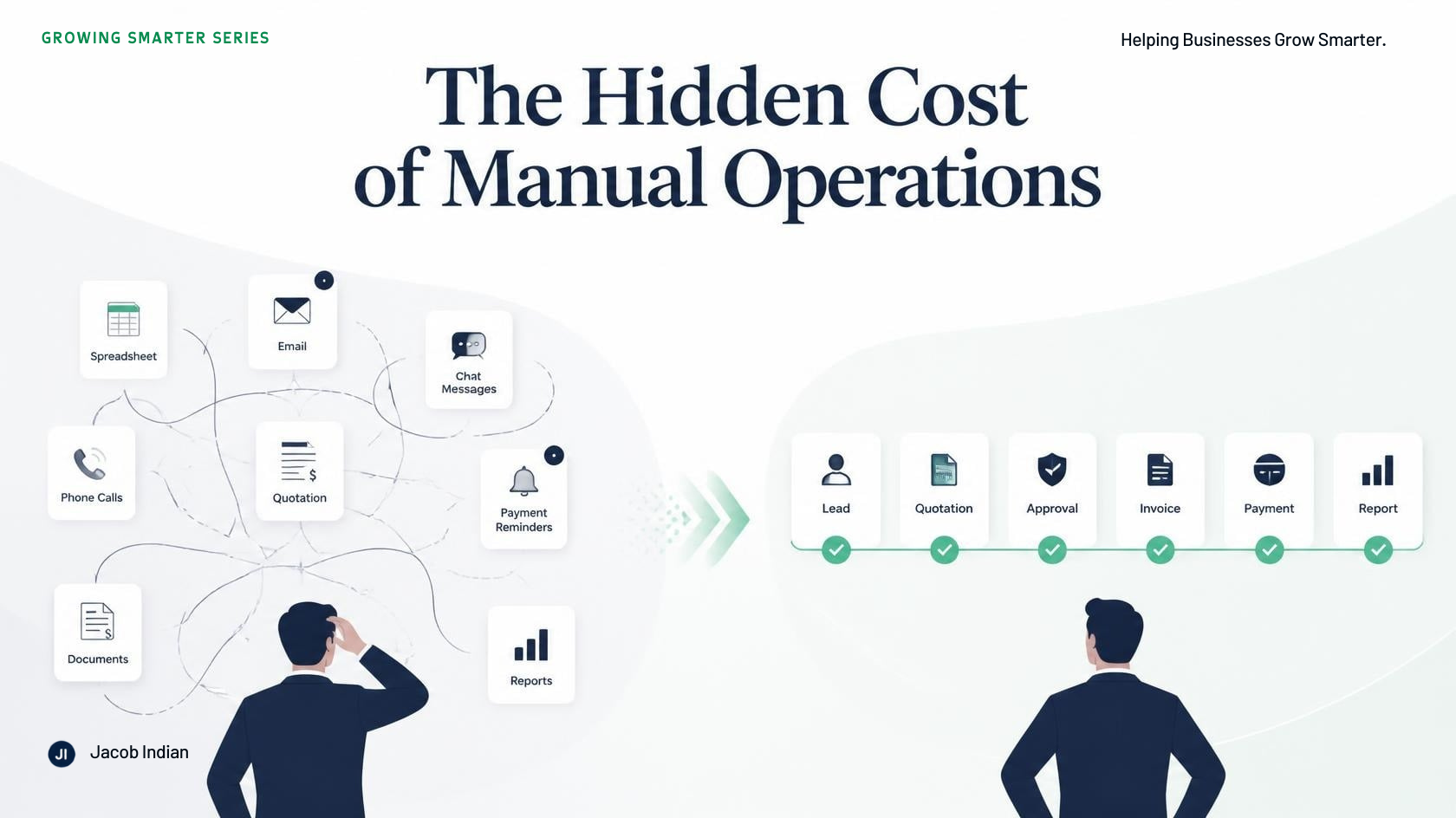
From Manual Tasks to Business Systems
A mature business doesn't necessarily eliminate people from its processes.
It eliminates unnecessary friction around them.
Instead of:
Quotation → Copy → Paste → Email → WhatsApp → Follow-up → Spreadsheet
you can build a defined workflow:
Lead → Quotation → Approval → Invoice → Payment
Each stage has a clear status.
Each person knows their responsibility.
The next step is visible.
Information doesn't have to be recreated at every stage.
That is what a business system should accomplish.
Systems Create Capacity
A good system doesn't simply save a few minutes here and there.
It creates capacity.
Capacity to serve more customers.
Capacity to handle more transactions.
Capacity for employees to focus on higher-value work.
Capacity for owners to focus on strategy instead of constantly solving operational problems.
This is one of the most important differences between working harder and building smarter.
A Simple Test for Your Business
Think about the last time you were asked:
“What's the status?”
How did you find the answer?
Did you:
- Open a spreadsheet?
- Search WhatsApp?
- Check email?
- Call someone?
- Ask another person?
- Look through a notebook?
- Wait for someone to respond?
Or could you see the answer immediately?
That simple question can reveal a surprising amount about the maturity of your business operations.
When Should You Start Changing?
You don't have to wait until manual operations become unbearable.
Some warning signs appear much earlier:
- Your team spends too much time entering the same information.
- Employees frequently ask each other for status updates.
- The owner is involved in routine decisions.
- Reports take hours to prepare.
- Follow-ups depend on someone's memory.
- Different people maintain different versions of the same information.
- A key employee being absent creates operational confusion.
These aren't necessarily signs that your business is failing.
They are signs that your business is growing beyond the way it used to operate.
Growth Requires Better Ways of Working
Every successful business starts somewhere.
Manual processes are often perfectly reasonable at the beginning.
The mistake is assuming that the same processes will remain appropriate forever.
As your business grows, your systems should grow with it.
That doesn't mean buying more software.
It means creating clearer processes, reducing unnecessary manual work, connecting information, improving visibility, and giving your team a consistent way to operate.
Because the goal isn't simply to make people work faster.
The goal is to make the business work better.
Growing Smarter
Growth shouldn't mean adding more spreadsheets, more WhatsApp messages, more approvals, and more hours to the working day.
It should mean building better ways for work to move through the business.
Manual operations may be invisible on your balance sheet.
But the time, errors, delays, dependencies, and missed opportunities they create are very real.
And eventually, every growing business reaches a point where working harder is no longer the answer.
Think About It
How many hours does your business lose every week doing work that could be handled by a better process or system?
Growing Smarter is a series by Jacob Indian exploring the realities of growing businesses, digital transformation, automation, and the systems that help businesses grow smarter.
Jacob Indian — Helping Businesses Grow Smarter.
Not sure where to start? Download our free Systems Readiness Checklist or book a consultation.
Related posts
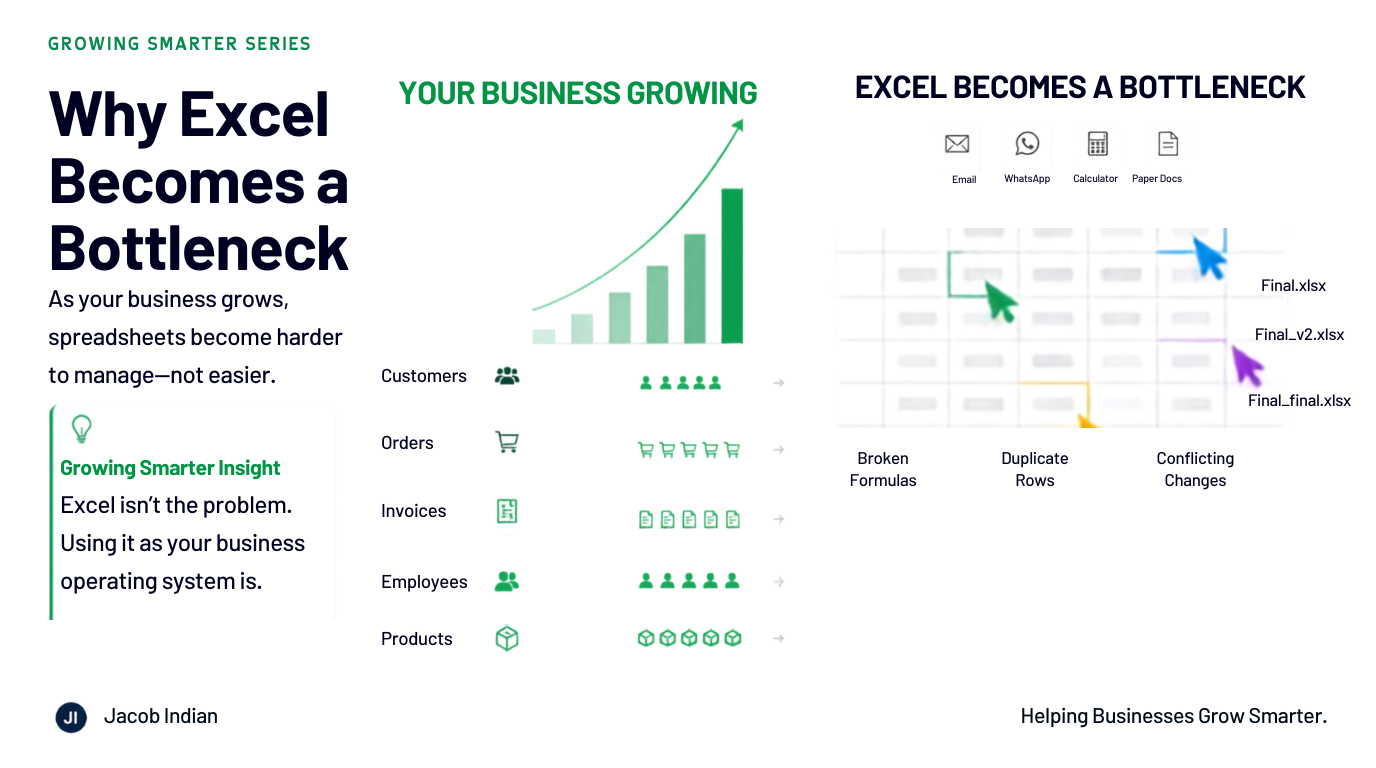
Why Excel Becomes a Bottleneck
Excel helps businesses start—but as complexity grows, spreadsheets quietly become the obstacle.

Is Your Business Running You?
There is a stage when you still run the business—but the business also starts running you. How to recognize owner dependency, and build processes that create capacity instead of chaos.

Independence for Your Business: Freedom to Grow Without Being Trapped in Operations
This Independence Day, another kind of freedom: run your business without your business constantly running you. Operational independence for growing SMEs.