Independence for Your Business: Freedom to Grow Without Being Trapped in Operations
This Independence Day, another kind of freedom: run your business without your business constantly running you. Operational independence for growing SMEs.
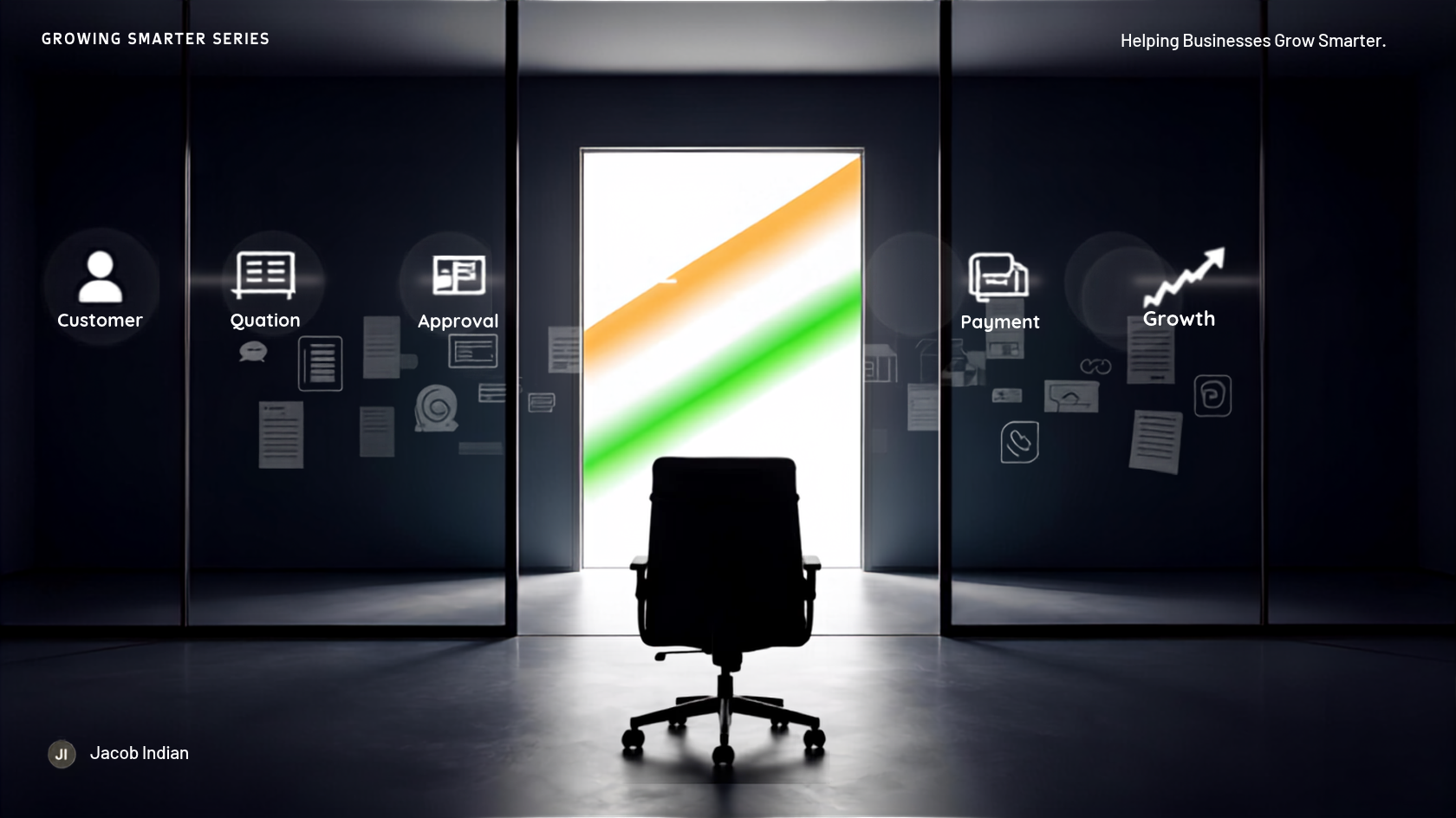
Growing Smarter #003 · Independence Day Special
Independence is often described as freedom from something.
But for a growing business, independence can mean something more valuable:
Freedom to focus on what matters.
Freedom to grow without adding unnecessary complexity.
Freedom to delegate without losing control.
Freedom to make decisions without searching through five different places.
Freedom to step away without everything coming to a standstill.
And most importantly:
When the Business Depends on You for Everything
In the early days of a business, being involved in everything is natural.
You know every customer.
You know which quotation is pending.
You remember who needs a follow-up.
You know which invoice hasn't been paid.
You approve every important decision.
You probably even know where the latest spreadsheet is.
At that stage, your involvement feels like leadership.
But as the business grows, something changes.
The same involvement can become dependency.
Your team starts asking:
“Should I send this?”
“Has the customer approved it?”
“Can you check the payment?”
“Which version should I use?”
“What happens next?”
Eventually, you aren't just running the business.
You have become part of every process.
The Hidden Cost of Being the Bottleneck
Owner dependency has a cost.
When routine work waits for the owner:
- Decisions take longer.
- Employees wait for approvals.
- Customers wait for responses.
- Work gets interrupted.
- Important tasks compete for attention.
- Even simple operations require constant supervision.
The business may still be growing.
But the owner's time becomes the limiting factor.
And there is a fundamental problem with that model:
Your business can only move as fast as you can.
We wrote more about this in The Hidden Cost of Manual Operations.
Business Independence Doesn't Mean Owner Independence
There is an important distinction here.
The goal isn't to make the owner irrelevant.
A growing business still needs leadership, strategy, relationships, judgment, and vision.
The goal is to remove the owner's involvement from routine operational decisions that don't require the owner's expertise.
Imagine the difference.
Instead of:
Employee → Owner → Decision → Employee → Customer
you build:
Defined Process → Responsible Person → Decision → Next Step
The owner can still see what's happening.
But they don't have to personally move every piece.
That's operational independence.
Freedom From Spreadsheets
Spreadsheets are useful.
They help businesses get started, organize information, calculate numbers, and manage early operations.
But as the business grows, spreadsheets can become repositories of fragmented information.
One file contains customers.
Another contains quotations.
Another tracks payments.
Someone has the latest version.
Someone else has a copy.
And the latest customer conversation?
Probably somewhere in WhatsApp.
The result is not necessarily a lack of information.
It's a lack of connected information.
The business has data.
But getting the right answer still requires searching.
If this sounds familiar, read Why Excel Becomes a Bottleneck.
Freedom From Repetitive Work
Consider how often businesses enter the same information repeatedly.
Customer details.
Product details.
Prices.
Tax information.
Payment terms.
Quotation information.
Invoice information.
When information is repeatedly copied from one place to another, people spend valuable time moving data instead of moving the business forward.
A better system captures information once and allows it to flow through the relevant process.
Less re-entry. Fewer opportunities for error. More time for meaningful work.
Freedom From Follow-Up Anxiety
“Did we follow up?”
It's a simple question.
But if the answer depends on someone's memory, a WhatsApp message, or a handwritten note, the process is fragile.
As the number of customers increases, so does the number of things that need attention.
A good process makes the next action visible.
Who needs to act?
What needs to happen?
When is it due?
What is the current status?
The goal isn't to eliminate follow-ups.
It's to eliminate the uncertainty around them.
Freedom From Scattered Information
Imagine asking:
“What is the current status of this customer?”
And needing to check:
- Excel
- Documents
- Phone conversations
- Someone's memory
That's not really visibility.
That's investigation.
Growing businesses need a clearer operational picture.
The right people should be able to understand what is happening without repeatedly interrupting other people.
Visibility creates independence.
Freedom From Approval Bottlenecks
Approvals are important.
But not every decision needs to reach the owner.
When every small decision requires the same person, that person becomes a bottleneck.
A better approach is to define:
- What requires approval
- Who can approve it
- When escalation is required
- What happens after approval
This allows routine work to continue while important decisions still receive the right level of attention.
Good systems don't remove control.
They make control more structured.
Freedom to Delegate
Delegation becomes difficult when knowledge exists only in someone's head.
If an employee says:
“Only I know how this works.”
you don't have a scalable process.
You have a dependency.
Documentation, defined workflows, responsibilities, and consistent procedures allow new people to understand how work gets done.
That makes delegation easier.
And when delegation becomes easier, growth becomes less dependent on a handful of individuals.
Freedom to Step Away
Here's perhaps the simplest test.
What happens if you don't work tomorrow?
Not because something went wrong.
Not because you are unavailable for an emergency.
Simply because you decided to step away.
Does the business continue?
Can your team:
- Find customer information?
- Check pending work?
- Send quotations?
- Follow established approval processes?
- Track invoices?
- Follow up with customers?
- Understand priorities?
- See what needs attention?
If the answer is yes, you've built something valuable.
You've built operational independence.
Independence Is a Business Capability
A business that depends completely on its founder can grow.
But eventually, growth becomes increasingly difficult.
A business with documented processes, connected information, clear responsibilities, visibility, and appropriate automation can create something different:
capacity.
Capacity to handle more customers.
Capacity to onboard employees.
Capacity to process more transactions.
Capacity to make decisions faster.
Capacity for the owner to focus on the future instead of constantly managing the present.
Independence Isn't About Doing Less
This is an important distinction.
Building better systems doesn't mean avoiding work.
It means removing unnecessary work.
You still need to serve customers.
You still need to make decisions.
You still need to lead your team.
You still need to grow.
But you shouldn't have to spend your best hours:
- Searching for information
- Copying data
- Checking status
- Chasing approvals
- Preparing repetitive reports
- Remembering every follow-up
Those are signs that the business needs better ways of working.
From Freedom From to Freedom To
This Independence Day, perhaps there is another way to think about business freedom.
Freedom from spreadsheets.
Freedom to access information.
Freedom from repetitive data entry.
Freedom to focus on higher-value work.
Freedom from scattered conversations.
Freedom to have visibility.
Freedom from approval bottlenecks.
Freedom to delegate.
Freedom from owner dependency.
Freedom to step away.
Freedom from operational chaos.
Freedom to grow.
The Business Should Give You Freedom
Building a business is supposed to create something bigger than yourself.
But if every additional customer creates more work for you...
If every new employee creates more questions...
If every increase in revenue creates more operational complexity...
then growth can start feeling like a burden instead of an achievement.
That's when it's time to rethink how the business operates.
Not necessarily by working harder.
Not necessarily by adding more people.
And not by simply buying more software.
But by building better systems for the way work moves through your business.
This Independence Day, Think About It
If you stepped away from your business for one week, would it continue to run—or would it wait for you?
True operational independence isn't about removing yourself from your business.
It's about giving yourself the freedom to work on the business, rather than constantly working inside it.
Growing Smarter is a series by Jacob Indian exploring the realities of growing businesses, digital transformation, automation, business systems, and the operational challenges that appear as companies scale.
Jacob Indian — Helping Businesses Grow Smarter.
Not sure where to start? Download our free Systems Readiness Checklist or book a consultation.
Related posts
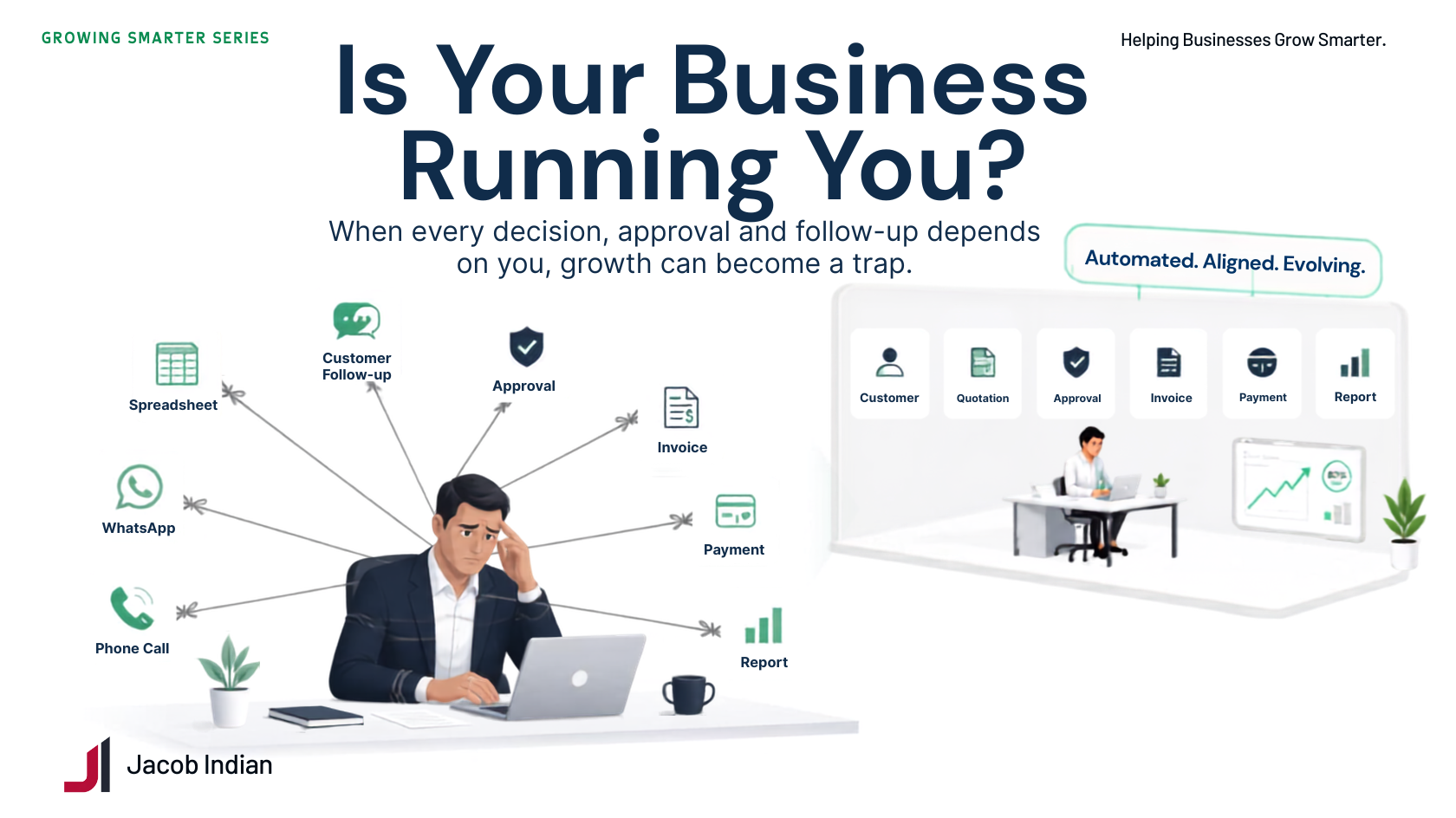
Is Your Business Running You?
There is a stage when you still run the business—but the business also starts running you. How to recognize owner dependency, and build processes that create capacity instead of chaos.
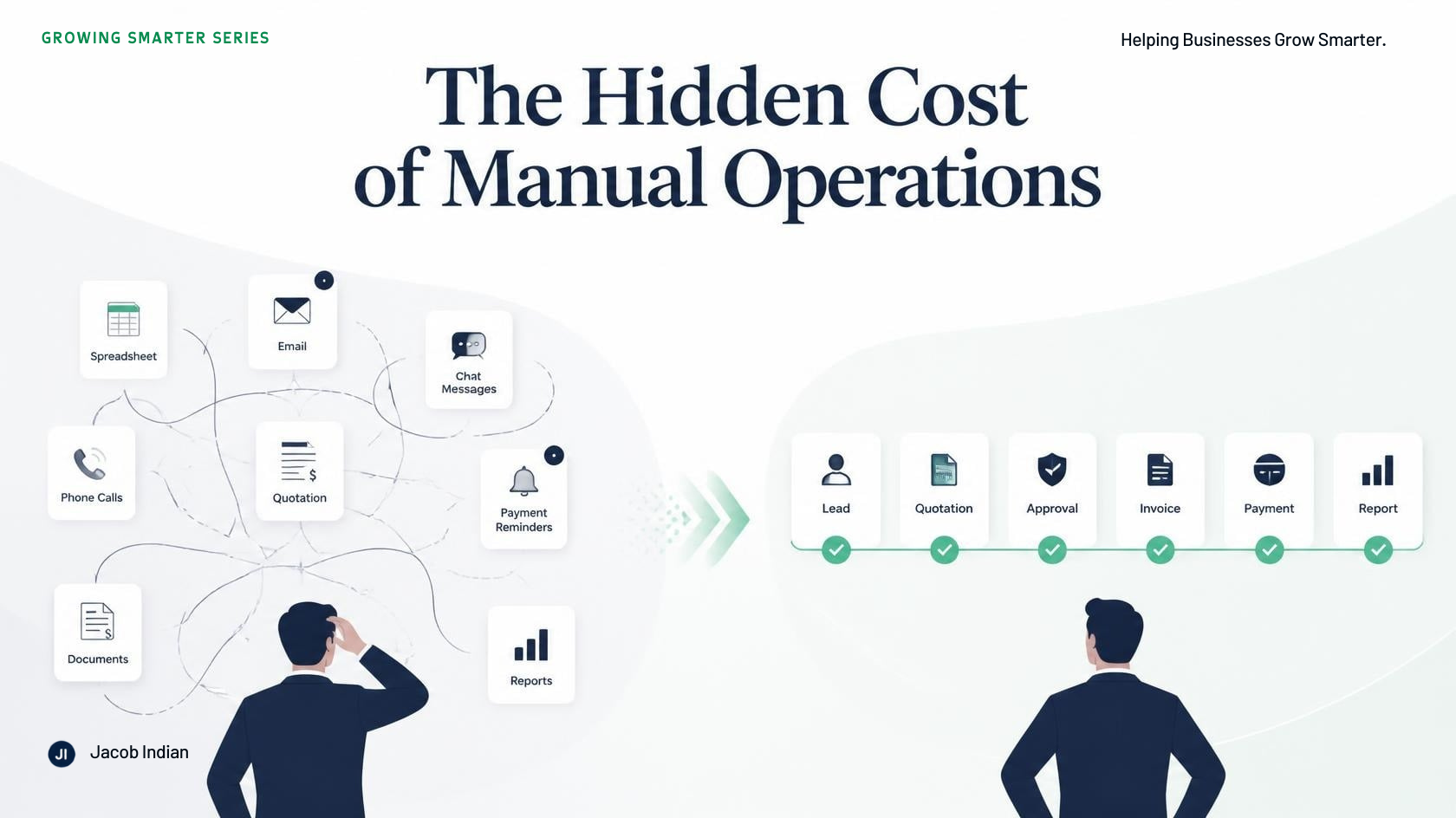
The Hidden Cost of Manual Operations
Manual work feels fine when you are small—until growth multiplies the same tasks. The hidden cost of manual operations, and why better systems beat working harder.
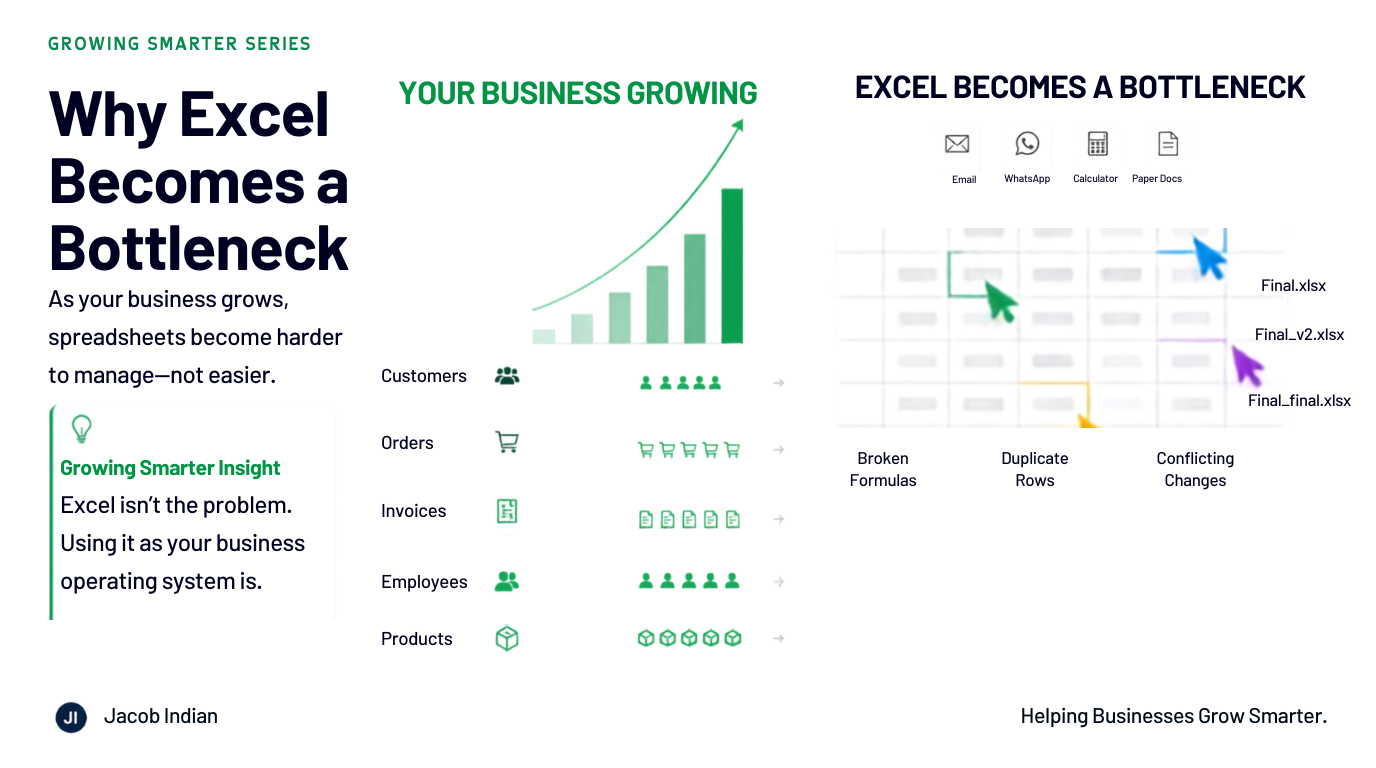
Why Excel Becomes a Bottleneck
Excel helps businesses start—but as complexity grows, spreadsheets quietly become the obstacle.